


Why Pre-Owned Off-Road Forklifts Are the Smart Investment for Rough-Terrain Material Handling
Introduction
Modern job sites rarely offer smooth concrete floors or flat staging areas. Civil construction projects, timber processing yards, and large-scale agricultural operations routinely operate across deep mud, loose gravel, unpaved inclines, and severely rutted terrain. Standard industrial forklifts are fundamentally incapable of operating under these harsh conditions, making specialized rough-terrain material handling machinery essential for daily productivity. To bridge the gap between heavy-duty lifting requirements and tight capital budgets, fleet operators are increasingly turning to the secondary market. Sourcing a high-performance pre-owned Off-Road Forklift allows contractors to navigate unforgiving ground conditions without incurring the steep acquisition costs of brand-new machinery.
Investing in pre-owned rough-terrain equipment enables companies to maximize fleet versatility while maintaining financial flexibility. Heavy-duty construction chassis, high-torque diesel engines, and oversized pneumatic tires are specifically engineered for structural longevity, ensuring that well-maintained pre-owned units perform reliably across demanding lifecycles. As Marcus Vance, Senior Heavy Machinery Fleet Director at Global Infrastructure Solutions, noted: "In rough-terrain logistics, structural integrity and drivetrain dependability are paramount; acquiring a thoroughly inspected pre-owned Off-Road Forklift provides identical site productivity and load stability as a new unit at a significantly lower total cost of ownership."
Ultimately, evaluating pre-owned rough-terrain material handling machinery is a strategic decision that aligns operational capability with long-term fiscal responsibility. By deploying a workshop-inspected pre-owned Off-Road Forklift, businesses gain immediate access to robust 4WD lifting capacity, higher ground clearance, and all-weather operational resilience—ensuring project deadlines are met without overextending capital reserves.
Key Financial & Operational Advantages of Buying Used Off-Road Forklifts
Acquiring a pre-owned Off-Road Forklift offers substantial financial benefits, starting with a significant reduction in capital expenditure. Brand-new heavy machinery incurs its steepest value depreciation within the first two to three years of operation. By purchasing a well-maintained pre-owned unit, business owners bypass this initial drop in asset value, acquiring heavy-duty material handling power at a fraction of original manufacturer prices.
From an operational standpoint, pre-owned equipment provides immediate project availability. Ordering a new rough-terrain forklift directly from an OEM factory often involves lengthy lead times due to manufacturing schedules and global supply chain delays. A pre-owned Off-Road Forklift, by contrast, can be sourced, workshop-tested, and delivered directly to active construction or agricultural sites within days, preventing costly site downtime and keeping project schedules on track.
Furthermore, rugged rough-terrain machinery boasts high resale stability and long-term durability. Built on heavy-duty reinforced steel frames and fitted with durable mechanical drivelines, a quality pre-owned Off-Road Forklift holds strong residual market value over time. When maintained with routine servicing, these machines remain highly liquid assets that can easily be resold or re-deployed across future project lifecycles with minimal financial loss.
Core Features to Look For in a Pre-Owned Rough-Terrain Unit
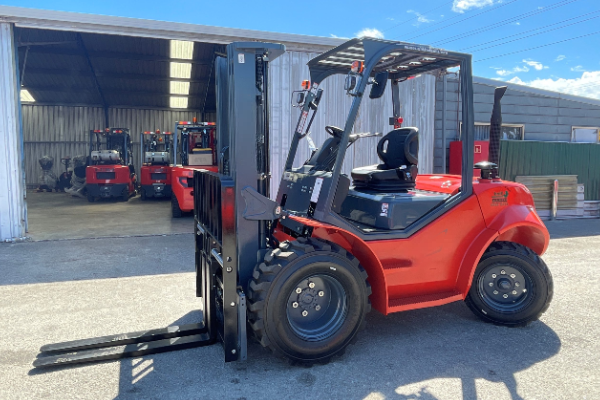
When selecting a pre-owned Off-Road Forklift, operators must evaluate core mechanical features that directly impact off-grid stability and lifting performance. Four-wheel drive (4WD) capability combined with high ground clearance and wide-track oscillating front axles is non-negotiable. These features ensure optimal tire contact, superior traction, and maximum lateral stability when navigating steep inclines, deep mud, or loose gravel while carrying multi-ton loads.
Evaluating mast lift capacity and tire condition is equally critical to site safety and load handling efficiency. Technicians should inspect heavy-duty duplex or triplex masts for structural alignment, smooth carriage operation, and minimal wear on load rollers. Furthermore, checking the tread depth and sidewall integrity of large-tread, deep-lug pneumatic or foam-filled rough-terrain tires ensures the Off-Road Forklift provides proper shock absorption and ground grip under maximum rated capacity.
Finally, verifying high-torque diesel engine performance and hydraulic system pressure is essential for reliable operation. A thorough inspection must confirm consistent oil pressure, smooth power delivery through the differential lock and torque converter, and leak-free hydraulic lift cylinders. Ensuring the hydraulic pump maintains consistent pressure under heavy load prevents premature power loss during continuous lifting operations.
Comprehensive Pre-Purchase Inspection Checklist
Conducting a rigorous, step-by-step physical and mechanical evaluation before purchasing a pre-owned Off-Road Forklift ensures operational safety and prevents unexpected repair costs on active job sites. The checklist begins with a detailed structural frame, chassis, and axle inspection. Technicians must examine heavy-duty stress points, planetary wheel hubs, and differential lock mounts for hidden weld fractures, frame distortion, or excessive play in the oscillating axle bushings caused by harsh terrain operations.
Next, a full assessment of the mast assembly, lift chains, and fork carriage system must be performed. Technicians should measure lift chain elongation against manufacturer wear tolerances, inspect mast channel rollers and bearings for excessive clearance, verify smooth side-shift cylinder motion, and inspect high-pressure hydraulic lines for outer jacket abrasion or fluid weeping near fitting couplings.
Finally, operators must conduct dynamic performance testing on the drivetrain and braking systems. Under operational conditions, test the transmission engagement across forward and reverse gears, verify seamless 4WD transfer case engagement under load, and test oil-immersed wet disc brakes on steep inclines to confirm emergency stopping power and parking brake holding capacity for the Off-Road Forklift.
Sector-Specific Application & Versatility of Used Off-Road Forklifts
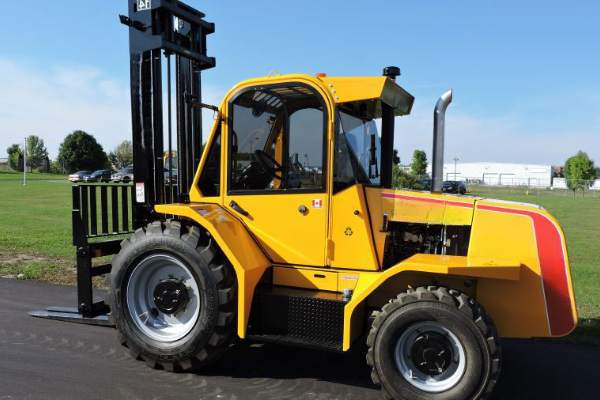
Deploying a pre-owned Off-Road Forklift across specialized industrial sectors unlocks exceptional operational versatility and task efficiency. In commercial construction and civil infrastructure projects, these heavy-duty units easily transport palletized brick masonry, structural steel rebar, and precast concrete modules across unpaved job sites, muddy access paths, and uneven scaffolding staging zones without risk of getting mired.
In agriculture, forestry, and lumber production, a pre-owned Off-Road Forklift delivers critical heavy-lifting capability across soft soil, fields, and unpaved timber yards. Operators rely on wide pneumatic tires, high ground clearance, and attachment flexibility—such as lumber grapples or hydraulic fork positioners—to move oversized logs, palletized timber, and high-volume produce containers efficiently during seasonal harvests.
Additionally, mining sites, oilfield installations, and remote logistics hubs utilize these machines to manage heavy industrial supply chains far from paved highways. Off-grid operations use a rugged Off-Road Forklift to offload freight containers, handle heavy drill pipe crates, and position spare machinery parts safely across rocky surfaces and remote staging facilities.
Conclusion
Investing in a pre-owned Off-Road Forklift offers heavy machinery buyers and fleet managers an unbeatable combination of rugged job-site performance, high lifting capacity, and capital efficiency. By avoiding initial depreciation costs and securing immediate machine availability, operators can easily handle challenging material handling tasks across mud, gravel, and unpaved terrain while maintaining a lean operational budget. When supported by a comprehensive mechanical pre-purchase inspection—focusing on chassis integrity, 4WD drivelines, mast assemblies, and hydraulic power—a quality pre-owned unit delivers the same heavy-duty productivity as a brand-new model at a drastically reduced total cost of ownership.
To maximize your return on investment, source your equipment from established B2B machinery exporters that offer workshop-tested units with verified inspection reports and transparent maintenance histories. Exploring pre-inspected, high-performance Off-Road Forklift inventory today allows your business to expand site handling capabilities, win demanding rough-terrain contracts, and drive long-term operational profitability.
Frequently Asked Questions About Off-Road Forklifts
What is the primary difference between a standard warehouse forklift and an Off-Road Forklift?
Standard warehouse forklifts are designed for smooth, level concrete floors with small, solid tires, minimal ground clearance, and standard two-wheel drive. In contrast, an Off-Road Forklift features large pneumatic or foam-filled deep-tread tires, high ground clearance, wide-track oscillating axles, robust 4WD drivelines, and reinforced chassis frames specifically built to maintain traction and load stability on mud, gravel, unpaved inclines, and rough terrain.
How many engine operating hours are acceptable when buying a used rough-terrain forklift?
For a pre-owned Off-Road Forklift powered by a reputable industrial diesel engine (such as Perkins, Cummins, or Yanmar), 3,000 to 6,000 well-maintained operating hours are considered ideal for secondary market acquisition. Machines up to 8,000 hours remain viable investments provided they have documented fluid change histories, verified hydraulic pressure levels, and sound structural frames.
Can an Off-Road Forklift be driven on smooth concrete or asphalt surfaces?
Yes. An Off-Road Forklift can operate on paved asphalt or concrete without issue. However, operating heavy deep-lug pneumatic tires continuously on hard, abrasive concrete will accelerate tire tread wear. Fleet operators working across mixed surfaces often select foam-filled or hard-compound rough-terrain tires to balance off-grid traction with paved surface durability.
Are replacement parts and hydraulic components readily available for older used rough-terrain models?
Yes. Major international brands utilize standardized industrial diesel engines, heavy-duty planetary axles, and common hydraulic valves across their rough-terrain ranges. Sourcing replacement mast chains, hydraulic seals, filter kits, and brake packs for a pre-owned Off-Road Forklift is straightforward through global heavy equipment dealer networks and aftermarket suppliers.
What key safety features should be tested before deploying a used unit on a slope?
Before operating a pre-owned Off-Road Forklift on inclined or soft ground, always test the parking brake holding strength under full load capacity, inspect the differential lock engagement to prevent single-wheel spin-out, verify operator Rollover Protective Structure (ROPS/FOPS) canopy integrity, and confirm that all hydraulic tilt and levelling safety lock valves operate without pressure drift.



Company: Shandong Chenxu Heavy Industry Co., Ltd.
WhatsApp: +86 187 6302 1167
Email: [email protected]